My list of the top 10 chess book covers, rated in order! Leningrad and "LISA" are clickable links. For artistic merit, "LISA" may be #1, but I have listed it last only to separate it from the conventional titles.
 John Stuart approves John Stuart approves Short version: MillBase is discontinued; try KingBase.
Long version: June 17, 2017: There will be no further updates to MillBase because I no longer own a computer or laptop and, consequently, no longer have access to SCID. I have just logged into Weebly for the first time in a year, and I could not figure out how to approve comments. Sorry about that - I had enabled moderation due to weird spam. I don't know why the DropBox link no longer works :( Side note: I have set about 15-20 chess-book auctions to run June 18-25, 2017 -- all starting at 99 cents. PEACE AND BEST WISHES TO ALL - REALLY MEAN THAT! Newly updated and upgraded, here is the database that I use with SCIDvsPC: MILLBASE1129 <--click to download The filename refers to the TWIC number. The file is 144 MB compressed (230 MB uncompressed). (I usually sort by "ECO,Rating," but I inadvertently sorted this file by the White player's name. No big deal.)
My goal with this database is to strike a balance of size and quality for regular use by chess hobbyists of all levels. At this point I also prefer and recommend SCIDvsPC over the original SCID.
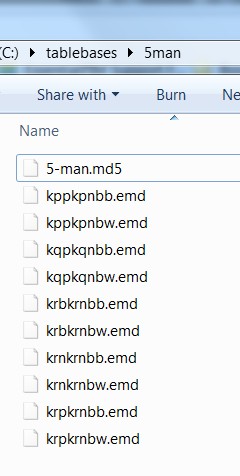
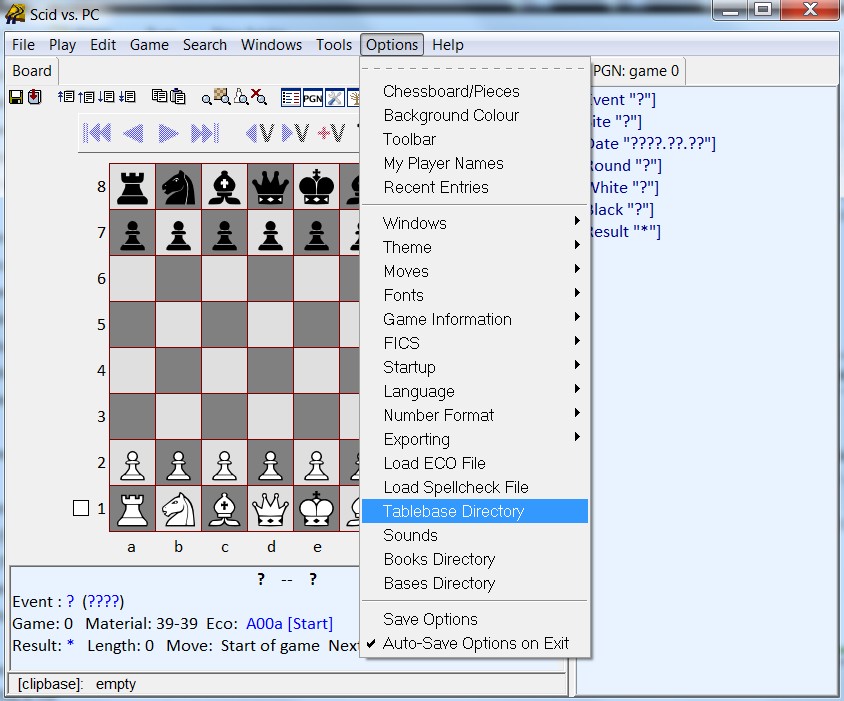
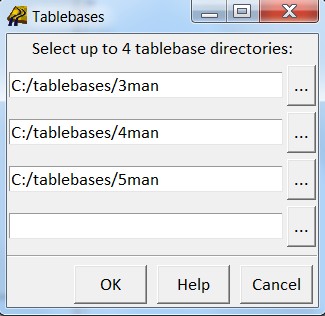
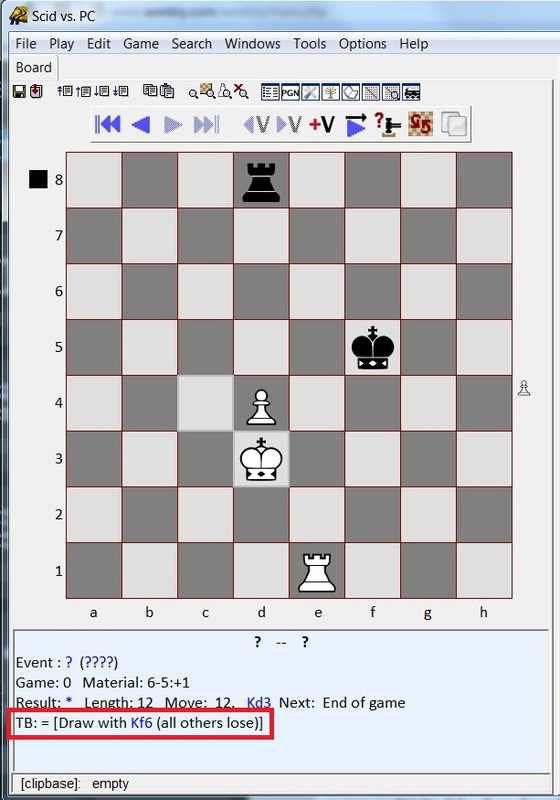
The above tablebase files total only 383 MB. To find the source files, look HERE and scroll down to the "3-4-5 men bases" heading. After setting up the entire 3- and 4-man directories, ou will have to locate and download the particular 5-man ".emd" files above. Then you will have to point SCID to the directories where they are saved. Before asking questions in the comments, please click/enlarge the screenshot images as I think these will clarify how this is supposed to work. For example, if you experience errors, save the tablebase folders directly in the "C:/" drive as shown in the pictures (a long path or spaces in the path can cause problems). This setup makes it a breeze to study theoretical endgames, for example, by transcribing Jesus de Villa's 100 Endgames You Must Know into a PGN file for further research and practice. You can still resort to online tablebases to review an endgame beyond the parameters of the tablebases shown above.  Youtube chess legend, Kingscrusher, has created an inspiring series on the career highlights of the top sacrificial artists in chess history. The artistic side of chess is rarely displayed in such clear focus. Who is next? Off the top of my head, these players are also famous for Sacrificial Artistry: Anderssen, Keres, Stein, Velimirovic, Hodgson, Hector, Topalov, Sutovsky, Jobava. Even within this league of sacrificial artists there are distinctions. Some approached chess with the subtlety of a chainsaw hacker, others played imaginative and fantastic conceptions (Nezh, Keres, Bronstein), still others conveyed a sense of epic/unrelenting power (Alekhine, Kasparov, Topalov). Viktor Korchoi, one of the greatest defenders, was quoted as saying that the greatest attackers in chess history through the 1970s were: Alekhine, Keres, and Spassky. I find this subject fascinating. I have made a detailed study of the Art of Sacrifice at my hobbyist level.
Here is my attempt to compile an enjoyable, practical, and fun 1.e4 repertoire based solely on high-quality(!) free videos hosted at YouTube. Most of the presenters are quite strong players/trainers! This is not an airtight or exhaustive repertoire but all the videos hit the big ideas and, for the most part, avoid drowning in minute details. I favored short and sweet videos, although the lengthy entry on the Scotch Game could not be omitted due to the charisma and practical strength of its presenters. Here is how the YT repertoire breaks down: Scotch Game presented by Kingscrusher (2200 FIDE) and Paul Gheorgiou (2300 FIDE) Sicilian, Czerniak-Gelashvili variation (2.b3) (and Part 2) by IM Andrew Martin French, Nunn-Korchnoi gambit by SuperChessGuru and siciliandragon28: Part 1, Part 2 Caro-Kann, Spassky gambit by GJ_Chess (or Two Knights by FM Charles Galofre: Part 1, Part 2) Scandinavian, Nf3/d4/c4 systems (and Part 2) by GJ_Chess Pirc, f3/g4 attack by Majnu2006 Alekhine, Balogh variation (4.Bc4) by IM Vojislav Milanovic As the Sicilian coverage is the lightest, here is a PGN of games played by Gelashvili in his pet line. I think it helps to think of the opening as a reversed Queen's Indian. 
Note: A full 1d4 YT repertoire has already been done by IM Christof Sielecki. Here is my list of the three best chess apps for Android (my opinion):
UPDATE: My favorites for puzzles are: TacticTrainer and EndgameTrainer, both by CoreGames. 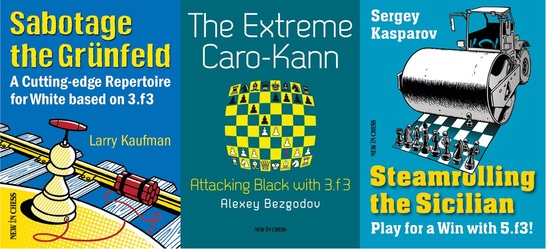
Everybody knows that the move f2-f3 drives a toothpick into Black's heart. White's only real concern is what moves to place around it as accompaniment. After carefully selecting an action verb in the present-progressive tense, a unique font, and high-contrast colors, I am proud to announce my forthcoming Opening Repertoire Book for White. Rock and roll. 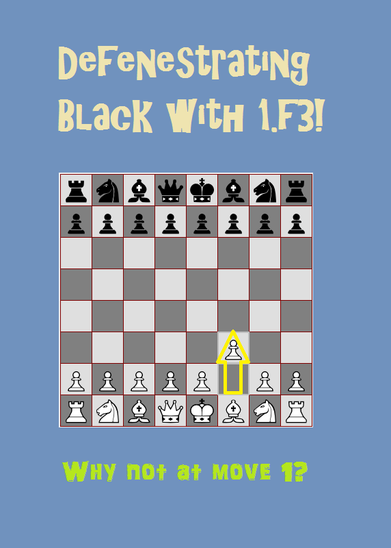
I wondered what a reading list based on the 16 world champions would look like. The 25 books in the slideshow probably contain approximately 1,800 games. I imagine that a person who actually studied all of them could not avoid reaching a playing strength of international standard. Although chess is lucky to have a rich written legacy from its lineage of champions, it is a shame that there are deficiencies in the list. For instance, there is no definitive book on Spassky, and Euwe's book on his own games has been out of print for 30+ years. I've read only 1.5 of the books in the slideshow: Capablanca's Best Endings by Chernev and Alekhine's My Best Games 1924-1937-- though I've read portions of Lasker's Manual and Capablanca's Chess Fundamentals. I've also read The Art of Attack by Vukovic, which is essentially a treatise on the middlegame methods of Capablanca and Alekhine. (Vukovic wrote that no master up to the time of publication, 1965, contributed anything to his subject that was not already fully developed by Capablanca and Alekhine!)
I can also give honorable mention to other worthy books along the same lines:
 Your suffering will be legendary. Your suffering will be legendary. “When you lose, you really feel a sense of self ... You actually feel that you are being taken apart, rather than just your pieces.”
--Viswanathan Anand The rest of Vishy's interview is published at the Financial Times. 'Tis one of the best chess interviews I've read in a while. Other champions speak of what it feels like to win, or as Vishy paraphrases Fischer in the article, "to crush a man's ego." Vishy talks about what it feels like to lose. But then, the last two decisive games between Anand and Carlsen were very painful, flesh-rendering ordeals. I am looking forward to this match! I want Magnus to win, but I don't think he should be a 3-1 favorite as the oddsmakers have it. Anything can happen in a short match, and Anand, at number 8 in the Live Ratings, is already playing on borrowed time and has nothing to lose. |
Author2076 USCF. Archives
July 2016
Categories
All
|
||||||

 RSS Feed
